Showing posts with label kefir. Show all posts

Thursday, 19 February 2015

fermented foods class


My dear friend Jane Slater asked me yesterday whether I thought fermented foods enhance our connection to Gaia.   I had never thought about it quite like that.  I definitely think natural raw foods do and it stands to reason that fermented foods with their incredible life force and multitude of life forms in them would increase the effect.  As humans, we are ecosystems much as our mother Earth is an ecosystem, teaming with different kinds of organisms.   A healthy person has more microorganisms in their gut than cells in their bodies, apparently.  Thing is we want them to be beneficial organisms and this is what this class is about; as well as producing a day's worth of incredibly tasty dishes of course.  You see me here preparing my mouth watering cherry chocolate kefir cheesecake, rich and delicious but totally easy to digest and actually light and healthy.  So, if you can, please come along.  Details and bookings here:

March 1st fermentation class

Wednesday, 26 November 2014

opening fermented beverages


Tutorial on how to  open naturally carbonated lacto fermented beverages such as jun, kombucha or even water kefir without t them exploding and going all over your kitchen/living room but more importantly  without wasting any.

Monday, 17 November 2014

weekend fermentation workshops

Bristol fermentation talk
chocolate kefir cheesecake at our Meare fermented foods class

I explain the wonders of kefir at our Meare class

Thank you Dunstan for your lovely comments "For me it wasn't 'just information'. There was some serious transmission of energy and frequencies in the room. I could feel my consciousness expanding with the words that were shared."
Click here for details of our classes in Meare, Somerset.

Friday, 3 October 2014

sparkford with kate magic


We had a wonderful time with such a great crowd at Kate's Sparkford retreat.  Kate invited us to talk about fermented foods: kefir, fermented vegetables and jun.  Thank you to everyone for your welcome and wonderful enthusiasm.  We were so taken with the venue and beautiful grounds that we may well do retreats there ourselves.  And also hoping to come to Jersey to do a class soon!


Wednesday, 16 July 2014

strawberries and cream

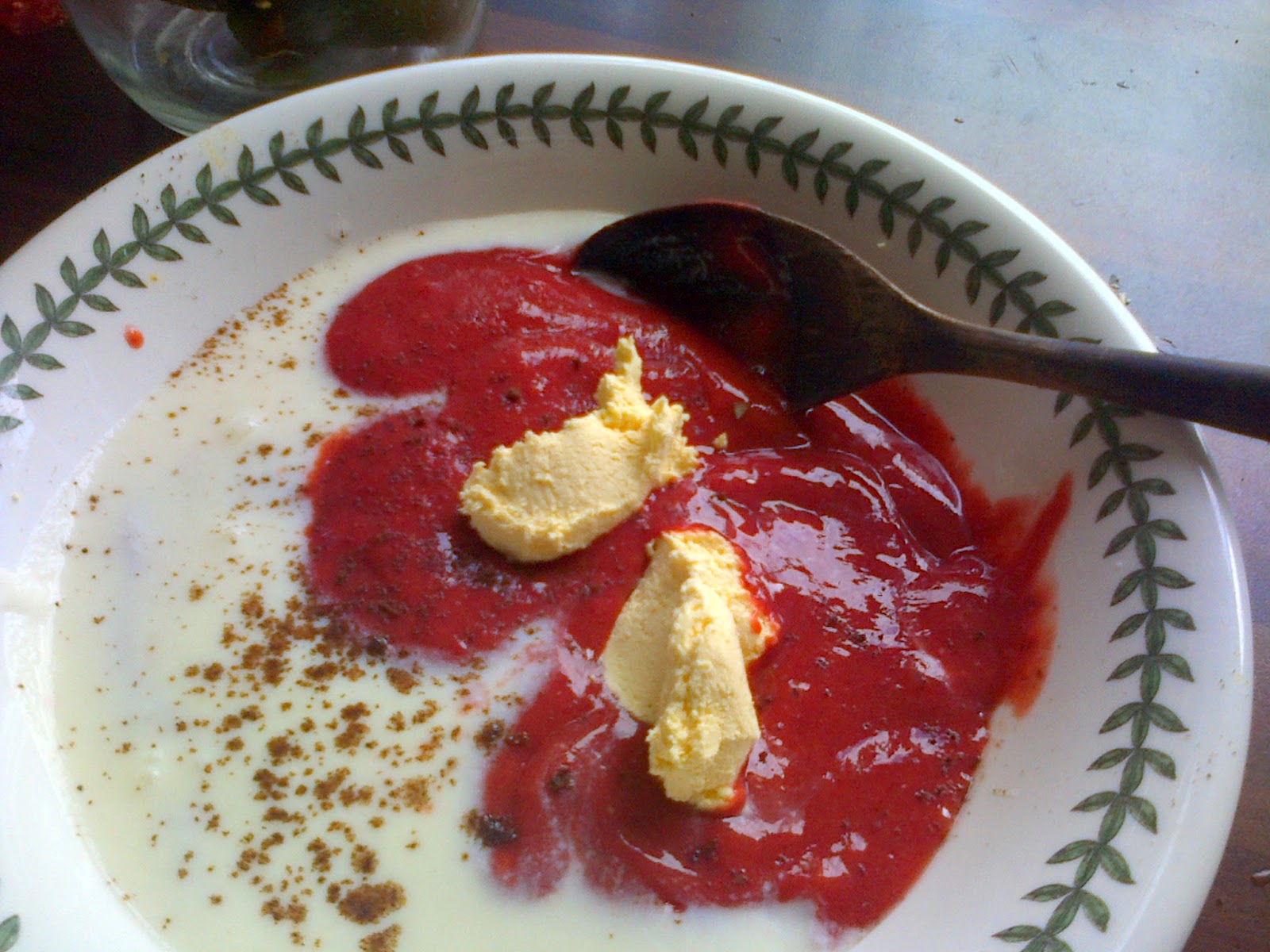
kefir, raw strawberry coulis and raw cream

So traditional and yet so updated.  And so delicious. 

Of course not that long ago dairy products such as milk and cream were not pasteurised so all our cream was raw.  Traditional diets around the world have taken what is available locally and adapted it to meet our nutritional requirements now that we are away from our wild biological habitats.  In the British Isles where we do not get consistent sunshine we have had other sources for vitamin D often through dairy products.  Pasteurising or heating them reduces the vitamin D content so is slightly missing the point.  

Fruit is a very natural food for humans to eat and strawberries are great as as most berries are with low glycemic indexes (they don't spike blood sugar levels) and with lots of vitamin C and also B17 especially if blended so the seeds become nutritionally available.  Throw in some noni and we're home!  So this is my recipe:

400g strawberries
40g dried mango, soaked
1 Tbsp raw honey

Just blend together until smooth.  If you use a vitamix you can just put in the dried mango as is; with a less powerful blender you are best to soak the dried fruit first in spring water.

Here I served this delicious coulis with kefir sprinkled with lucuma powder and vanilla powder as well of course the dollop of raw cream on top.  We have our kefir delivered from Dreamers Farm.  You can see  a list of raw dairy suppliers here.

Saturday, 8 March 2014

fermented foods ~ instant energy for the brain

kefir with yacon, a prebiotic
We have been finding from experience that fermented foods such as kefir and kraut and jun give us a particular instant energy boost that we don't experience from other foods.  This intrigues us and we have been wondering what is the explanation.  With the question about what is the ideal fuel for the brain on my mind I came across the information below.

First thing to mention is that while glucose is an oxidative fuel for our bodies and brains,  it is actually used to make ATP or adenosine triphosphate which is a  usable form of energy for cells - "the energy is "trapped" in a chemical bond that can be released and used to drive other reactions that require energy. (endergonic reactions)."   http://scienceline.ucsb.edu/getkey.php?key=2254


So how do we go from glucose to ATP? "This is achieved through the process of "oxidation" - and this is carried out through a series of metabolic pathways. Complex chemical transformations in the cell occur in a series of separate reactions to form each pathway, and each reaction is catalyzed by a specific enzyme. Interestingly, metabolic pathways are similar in all organisms, from bacteria to humans. In eukaryotes (plants and animals) many of the metabolic pathways are compartmentalized, with certain reactions occurring in specific organelles. Basically, cells trap free energy released from the breakdown (metabolism) of glucose. This energy gets trapped in the ATP as it converts from ADP to ATP by the addition of phosphate.
There are 3 main pathways for harvesting energy from glucose:
Glycolysis - begins glucose metabolism in all cells to produce 2 molecules of pyruvate. Occurs outside of mitochondria, usually in cytoplasm.
Cellular Respiration - uses oxygen from the environment and converts each pyruvate to three molecules of carbon dioxide while trapping the energy released in this process in ATP. There are 3 sub-pathways of cellular respiration - pyruvate oxidation, the citric acid (Krebs or Tricarboxylic Acid) cycle and the electron transport chain. Occurs in different sub-compartments of mitochondria.
Fermentation - converts pyruvate into lactic acid or ethanol; does not need oxygen. It is not as efficient as cellular respiration; it occurs in the cytoplasm." http://scienceline.ucsb.edu/getkey.php?key=2254

We want to look more into this but on first sight  it seems we have an explanation, we are using the help of friendly micro-organisms to convert the sugars on milk or vegetables or honey into ATP, an immediate energy source for the body and brain.

Now the brain uses a  lot of energy, a high percentage of the body's energy requirements.  Glucose is  a very immediate source of oxidative fuel for ATP production (and it seems the brain does need at least some glucose) while the breaking down of fat, protein of glycogen is a bit more long-winded.  However it seems to us that fermented foods can supply instant brain energy without having to take in a lot of fruit sugar which, as many of us know can cause challenges to our bodies in other ways.

Could it be that in order to advance our evolution as a species we do need a more instantly accessible source of large amounts of energy for the brain and that by engaging harmoniously with friendly micro-organisms we have this?

Friday, 28 February 2014

kefir grains will travel


I just had this lovely message from  a lady who ordered our dehydrated kefir grains to go to Auroville in India:

'I thought that I would give you an update of the Kefir Grains that you
sent me.

"Well they have been so popular in the Ashram and Auroville. They are growing so fast in that environment - doubling every 2 or 3 days. Anyway as they do get a lot of visitors, the grains have reached Africa America and various parts of India. I found this quite incredible and i thought i might let you know. So Thank you from many people who have seen the benefits." '

Of course I was so happy and grateful to hear this.  And also very relieved to hear how well the dehydrated kefir grains travel and rejuvenate at their destination.  There is magic at work with this living culture.  Living culture is global, it's of the Earth and longing to propagate.

Sunday, 23 February 2014

our fermentation fetish workshop


making chocolate kefir cheesecake...
the final touch...
Our workshop went so well yesterday, we always get very appreciative feedback and this was a particularly fun day.  Here is what Chris Paradox, Vandita and Alan had to say afterwards, they really capture the mood of the event.


We feel this is a new generation of raw food, by fermenting gourmet raw food or using fermented foods to make the dishes, it is brought to life and becomes infinitely more digestible.

Next one is 22nd March.  Click here to find out more.

Sunday, 26 January 2014

our fermentation fetish class in meare

We are really enjoying teaching these classes and the very appreciative feedback.  Yesterday we made lacto fermented Mexican salsa


basil kefir cheese pesto

lacto fermented pineapple papaya curry chutney


coconut kefir ginger beer

kefir breakfast pudding

chocolate kefir cheesecake


We also demonstrated kraut made easy 


and the ins and outs of making kefir.


These classes are also a great introduction to making raw food work for you.


Next one is on 22nd February,  Meare is in Somerset, about four miles from Glastonbury.

Thanks to Anna Middleton for fabulous photos.

Tuesday, 31 December 2013

raw dairy, health and ethics

Here's an audio piece I did talking about the role of dairy products in a raw food lifestyle for health and also putting the ethics into perspective hopefully!  Underneath is the basic flow of my thoughts on this subject:


1.  It seems that most people need to consume some animal material for fat soluble vitamins or bring in some processed fortified foods.

I am not talking about the exceptions that prove the rule here but am concerned with the majority.  It seems that in the long term most people need to consume animal fats in order to obtain the fat soluble vitamins A,D nad K in the form that the body can use; in the case of vitamin A this is retinol and in the case of vitamin D, D3.  All traditional cultures that we know of and as studied by Weston Price consumed at least some animal products, in general the further they were from the equator, the higher the ratio of animal to plant foods.

If at some point we lived a frugivorous diet in the forest, this would have included all kinds of insect material.

Grazing animals such as cows, goats and sheep not only consume insects along with a great variety of grasses and herbs, they are also out naked absorbing sunlight while we are indoors.  These animals can absorb the nutrients they need from the vegetation insects and sunlight in latitudes where humans need to clothe themselves, house themselves and cannot absorb the vitamin D they need from the sun.  We have traditionally piggybacked in this way off animals indigenous to these climates, whether we have used their milk or eaten their flesh.

2. So, given our current circumstances what are the healthiest, most efficient and ethical ways of taking in the fats we need?

Looking at flesh foods, apart from even the various ethical questions around the meat and fishing industries, meat and fish are actually quite difficult foods for us to digest.  Most of us would not be willing to spend our days foraging for insect filled fruit and it could even be that our digestive systems could no longer extract what we need from such a  diet.  It could  be argued that we are not designed to drink the milk of another animal or drink milk after childhood but at least we do have a an inherent capacity to digest mammal milk in our design because we are designed to drink our mother's milk as children.   We then can apply techniques of fermentation to make these milks even more digestible for us. For example the kefir culture breaks down casein, and lactose and changes the ratios of the amino acids in the milk to be more suitable for humans.

3. What are the broader ethical issues?

As a  species we have kept domesticated animals for a long time and have developed an interdependent relationship with them.  We have also developed a three way interdependence, a symbiotic relationship between ourselves, the animals, and the organisms in the cultures such as kefir used to ferment the milk. This is an ecosystem in itself. worthy of sustaining.  The cultures and animals that have been domesticated for so many years would not fare well if we abandoned them.  The damage to the planetary ecosystem and thus indirect harm to animals may actually be greater by the manufacturing or importing of other foods that we might use to replace dairy products.

We cannot separate out plant and animal life.  Even plants are feeding off soil which includes broken down animal waste.  The compassionate way is not to try to remove animal input but to avoid animal cruelty and connect to the animals.  A lot of this is about economics. Now, economic demand is leading  some farms to treat milking animals in much more caring ways such as letting calves stay with their mothers and keeping on  cows who have stopped milking to retire gracefully in the fields.  An example of such a dairy is the Calf at Foot Dairy. http://www.the-calf-at-foot-dairy.co.uk/  The milk from such dairies is noticeably more delicious.

4.  Why is this such a significant issue?

The question of whether it is acceptable to eat animal products seems to be a perennial one in the raw food scene and people get very heated about it, to an extraordinary degree.  I feel passionately about it for several reasons - health, freedom and reaching our full potential. Firstly I want people to be healthy, secondly because I want people to be free of imposed anti-human beliefs and thirdly I passionately believe that eating natural raw foods that fit our biology as a species is an integral part of us reaching our full potential and I don't like seeing this being undermined.

I have covered the issue of health above in connection with fat soluble vitamins, we also need to think about where we get omega 3 fatty acids DHA and EPA, there are other factors in animal foods too.

Then we come to the imposed beliefs.  Animal and plant life, not to mention human life is intertwined on this planet, that's just the way it works.  The idea of not in any way consuming anything that has at some point come from an animal is just a concept with no genuine reality.  It is something very different to the genuine connection and compassion that humans naturally feel towards other mammals.  A disconnected belief that makes it difficult for humans and especially the young to get the nutrition that they need really is anti-human.

And thirdly about human potential, getting undamaged (i.e. not heated above biological temperature) nutritional components can rebuild our neurological system to another level.  Essentially this means a nutrient dense predominantly raw and predominantly but not exclusively plant based diet.  To sabotage this with another contradictory thought stream which suggests it is wrong to do what we need to do to get vital nutrients seems to me unwise to say the least and thoroughly confusing and unproductive for someone who is improving their diet with a view to fulfilling their potential.  As so much on this planet hangs on humans coming out of their stupor and reaching towards their divine endowment, it seems ethical in the deepest sense to obtain whatever nutrition we need to take from other animals in the most respectful way possible.

Saturday, 7 December 2013

kefir, magic elixir, champagne of raw dairy


Kefir is an incredible magic food which comes into being through the symbiotic activities of three living groups: humans, grazing animals and beneficial micro-organisms. The culture which, with human help, transforms animal milks into a supremely nourishing drink is actually a mixture of numerous kinds of friendly bacteria and yeasts. Our bodies are really a whole ecosystem and ideally our digestive tracts contain ten times more friendly micro-organisms than we have cells in our bodies; these support a healthy immune system and brain function. Kefir is the most powerfully probiotic food or supplement that we know of. It actively repopulates the gut, laying down a healthy mucus layer that micro-flora can flourish in, supporting the digestive and immune system.

The kefir culture itself is potentially immortal – if properly looked after and fed with milk, it can live indefinitely. The liquid kefir that it makes is a preserved living food and can keep for months. The particular nutritive properties of kefir are numerous. The culture rebalances the amino acids in animal milk making them more suitable for humans. In particular it increases the amount of tryptophan which is the raw material from which serotonin, the well-being biochemical, is made. Tryptophan tends to be lacking in modern diets as it is easily damaged by cooking. Kefir contains ample amounts of B vitamins including B12. Acetylcholine in it improves sleep and is good for memory, intelligence, learning, enthusiasm and general mood. It contains lecithin which helps in the assimilation of fats. It contains 'right-rotating' lactic acid (as opposed to 'left-rotating' lactic acid found in other yoghurts) which revives cells.

One of the great aspects of kefir is that it allows us to take advantage or the nutrition in dairy milk, for example the fat soluble vitamins A (retinol), D and K2 whilst avoiding some of the potential allergenic problems of dairy products. The culture breaks down the lactose into lactic acid and the casein into beneficial peptides.

Added to all this, kefir has an unusual, delicious and acquired taste. When bottled,  it undergoes a secondary fermentation and becomes slightly fizzy - the 'champagne of raw dairy'. 

Monday, 14 October 2013

raw chocolate kefir cheese cake

You need 300g kefir cream cheese and a batch of molten raw chocolate

Kefir Cream Cheese:
You can make kefir cream cheese  in two ways:
One is to pour kefir liquid into a muslin or nylon straining bag and hang over a container to catch the whey.  Leave for 24 hours and you have kefir cheese in the bag.  Alternatively leave kefir liquid in a kilner jar for a few days so that the creamy curds and clear whey separate out.  Then you can spoon the kefir cream off the top.  It works much better with the thick kefir you get from Jersey or Guernsey cows' milk.

Chocolate:
To make the chocolate you need the folloing ingredients:
110g cacao butter
50g cacao paste
3 Tbspns yacon syrup
pinch cayenne
pinch Celtic sea salt
4 Tbspns lucuma powder
1 Tbspn maca
1 tspn he shou wu
1 Tbspn strawberry powder
1 Tbspn fig powder
1 Tbspn purple corn
¼ tsp vanilla powder
¼ tsp blue green algae

Melt cacao paste and butter over hot water, add yacon and salt
Mix dry chocolate ingredients
Stir paste and butter mixture into dry ingredients

Making the Cheesecake:
Stir the molten chocolate into the cream cheese thoroughly and mould into cake shape.

Tuesday, 1 October 2013

wonders of kefir

Milk kefir is one the major staples of our diet.  There are many wonderful things about it.  Not least is that it enables us to benefit, with digestive ease, from the goodness in raw dairy milk, including the crucial fat soluble vitamins D and K2 and also various B vitamins which are otherwise difficult to obtain in sufficient quantities from a plant sourced diet.  In high latitude countries such as Britain it is not possible to obtain vitamin D from sunlight for about half of the year due to the low altitude of the sun. 

Kefir transforms the milk of another mammal, for example a cow, so that the ratios of the amino acids are more suitable for humans.  In particular in increases the amount of tryptophan which it is very easy to be deficient in and is the precursor to serotonin.  The kefir culture also breaks down difficult to digest casein proteins into peptides and lactose, which is  a problem for many, into lactic acid.  Kefir is  the most powerful probiotic substance we know of, actively repopulating the gut with friendly bacteria. 

If you make your kefir with the milk from traditional A2 type cows such as Jersey cows, then all the better. This milk does not release a particular beta-casomorphine called BCM 7 which is responsible for some milk intolerance.  Jersey milk also contains more cream therefore more fat soluble vitamins.(more below).

We integrate noni powder into some of our kefir meals.  The xeronine in noni helps the tryptophan get through the intestinal walls more effectively.

Demonstrating kefir at Dutch Raw Food Festival:


at our workshop:


addendum on A1 and A2 milk:

"All proteins are long chains of amino acids. Beta casein is a chain 229 amino acids in length. Cows who produce this protein in their milk with a proline at number 67 are called A2 cows, and are the older breeds of cows (e.g. Jerseys, Asian and African cows). But some 5,000 years ago, a mutation occurred in this proline amino acid, converting it to histidine. Cows that have this mutated beta casein are called A1 cows, and include breeds like Holstein.

Proline has a strong bond to a small protein called BCM 7, which helps keep it from getting into the milk, so that essentially no BCM 7 is found in the urine, blood or GI tract of old-fashioned A2 cows. On the other hand, histidine, the mutated protein, only weakly holds on to BCM 7, so it is liberated in the GI tract of animals and humans who drink A1 cow milk."
http://articles.mercola.com/sites/articles/archive/2009/07/09/the-devil-in-the-milk.aspx