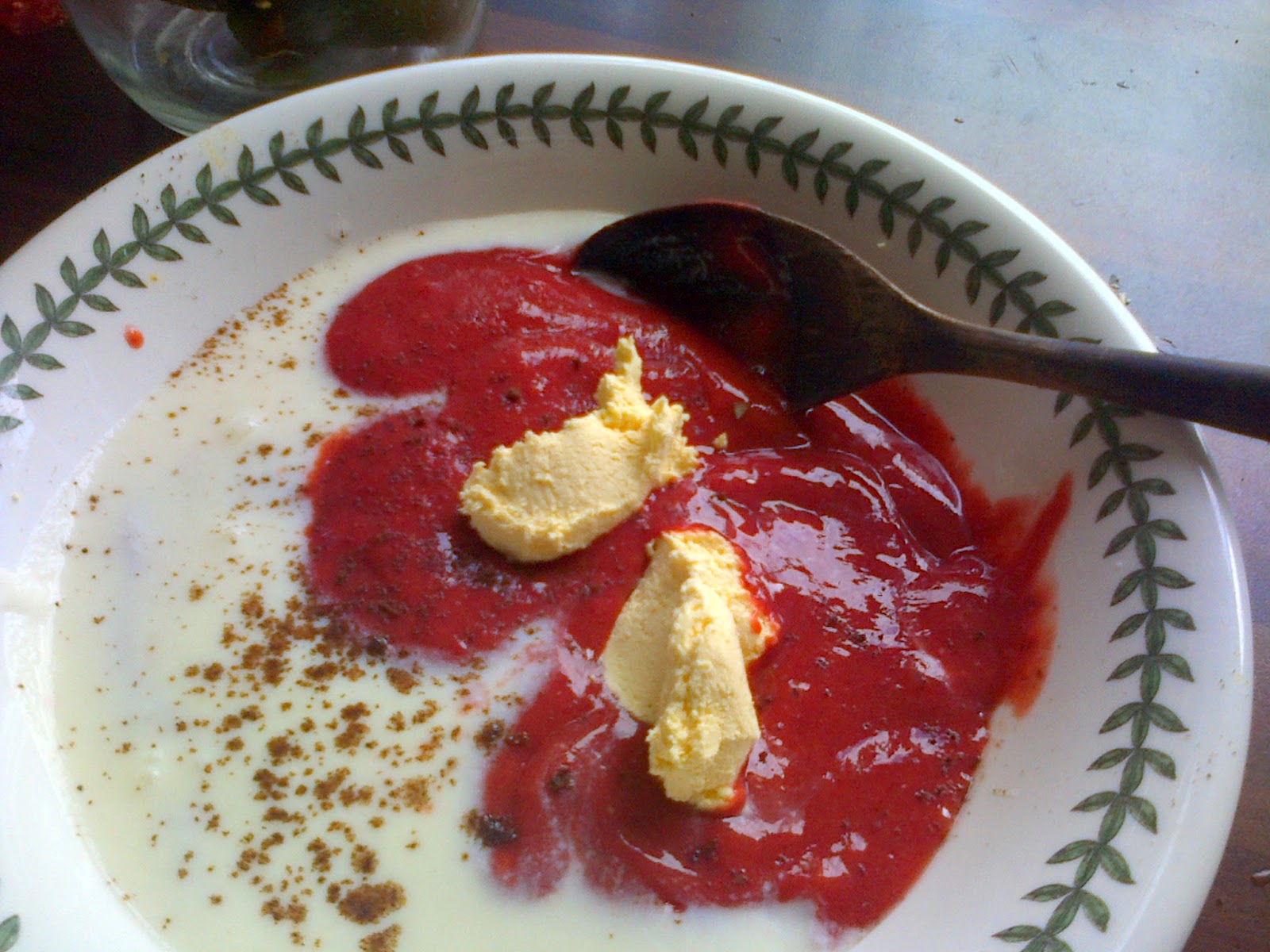
Here's an audio piece I did talking about the role of dairy products in a raw food lifestyle for health and also putting the ethics into perspective hopefully! Underneath is the basic flow of my thoughts on this subject:
1. It seems that most people need to consume some animal material for fat soluble vitamins or bring in some processed fortified foods.
I am not talking about the exceptions that prove the rule here but am concerned with the majority. It seems that in the long term most people need to consume animal fats in order to obtain the fat soluble vitamins A,D nad K in the form that the body can use; in the case of vitamin A this is retinol and in the case of vitamin D, D3. All traditional cultures that we know of and as studied by Weston Price consumed at least some animal products, in general the further they were from the equator, the higher the ratio of animal to plant foods.
If at some point we lived a frugivorous diet in the forest, this would have included all kinds of insect material.
Grazing animals such as cows, goats and sheep not only consume insects along with a great variety of grasses and herbs, they are also out naked absorbing sunlight while we are indoors. These animals can absorb the nutrients they need from the vegetation insects and sunlight in latitudes where humans need to clothe themselves, house themselves and cannot absorb the vitamin D they need from the sun. We have traditionally piggybacked in this way off animals indigenous to these climates, whether we have used their milk or eaten their flesh.
2. So, given our current circumstances what are the healthiest, most efficient and ethical ways of taking in the fats we need?
Looking at flesh foods, apart from even the various ethical questions around the meat and fishing industries, meat and fish are actually quite difficult foods for us to digest. Most of us would not be willing to spend our days foraging for insect filled fruit and it could even be that our digestive systems could no longer extract what we need from such a diet. It could be argued that we are not designed to drink the milk of another animal or drink milk after childhood but at least we do have a an inherent capacity to digest mammal milk in our design because we are designed to drink our mother's milk as children. We then can apply techniques of fermentation to make these milks even more digestible for us. For example the kefir culture breaks down casein, and lactose and changes the ratios of the amino acids in the milk to be more suitable for humans.
3. What are the broader ethical issues?
As a species we have kept domesticated animals for a long time and have developed an interdependent relationship with them. We have also developed a three way interdependence, a symbiotic relationship between ourselves, the animals, and the organisms in the cultures such as kefir used to ferment the milk. This is an ecosystem in itself. worthy of sustaining. The cultures and animals that have been domesticated for so many years would not fare well if we abandoned them. The damage to the planetary ecosystem and thus indirect harm to animals may actually be greater by the manufacturing or importing of other foods that we might use to replace dairy products.
We cannot separate out plant and animal life. Even plants are feeding off soil which includes broken down animal waste. The compassionate way is not to try to remove animal input but to avoid animal cruelty and connect to the animals. A lot of this is about economics. Now, economic demand is leading some farms to treat milking animals in much more caring ways such as letting calves stay with their mothers and keeping on cows who have stopped milking to retire gracefully in the fields. An example of such a dairy is the Calf at Foot Dairy.
http://www.the-calf-at-foot-dairy.co.uk/ The milk from such dairies is noticeably more delicious.
4. Why is this such a significant issue?
The question of whether it is acceptable to eat animal products seems to be a perennial one in the raw food scene and people get very heated about it, to an extraordinary degree. I feel passionately about it for several reasons - health, freedom and reaching our full potential. Firstly I want people to be healthy, secondly because I want people to be free of imposed anti-human beliefs and thirdly I passionately believe that eating natural raw foods that fit our biology as a species is an integral part of us reaching our full potential and I don't like seeing this being undermined.
I have covered the issue of health above in connection with fat soluble vitamins, we also need to think about where we get omega 3 fatty acids DHA and EPA, there are other factors in animal foods too.
Then we come to the imposed beliefs. Animal and plant life, not to mention human life is intertwined on this planet, that's just the way it works. The idea of not in any way consuming anything that has at some point come from an animal is just a concept with no genuine reality. It is something very different to the genuine connection and compassion that humans naturally feel towards other mammals. A disconnected belief that makes it difficult for humans and especially the young to get the nutrition that they need really is anti-human.
And thirdly about human potential, getting undamaged (i.e. not heated above biological temperature) nutritional components can rebuild our neurological system to another level. Essentially this means a nutrient dense predominantly raw and predominantly but not exclusively plant based diet. To sabotage this with another contradictory thought stream which suggests it is wrong to do what we need to do to get vital nutrients seems to me unwise to say the least and thoroughly confusing and unproductive for someone who is improving their diet with a view to fulfilling their potential. As so much on this planet hangs on humans coming out of their stupor and reaching towards their divine endowment, it seems ethical in the deepest sense to obtain whatever nutrition we need to take from other animals in the most respectful way possible.